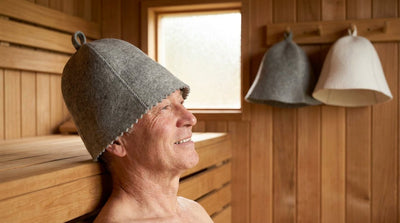
Walk into a Russian banya or a well-loved Finnish sauna and you'll spot something that puzzles almost every first-timer: people sitting in 190°F heat wearing thick felt hats. Wool. In a sauna. On purpose. It looks like a prank, but it's actually one of the smartest pieces of gear in bathing culture — and the reason comes down to some genuinely satisfying physics. Let's unpack why a hat that would keep you warm in a snowstorm also keeps you comfortable in a hot room.
The Short Answer: Insulation Works Both Ways
We tend to think of insulation as something that keeps heat in — a winter coat, a thermos of coffee. But insulation doesn't have a preference. It simply slows the movement of heat from wherever it's warmer to wherever it's cooler. In winter, that means your body heat stays inside your coat. In a sauna, the situation flips: the air is far hotter than you are, so an insulating layer slows heat moving into your body.
A thermos is the perfect analogy. It keeps hot coffee hot and iced tea cold using the exact same walls. A sauna hat is a thermos for your head — it doesn't cool you down so much as it buys your head time, keeping it noticeably cooler than the air around it while the rest of your body soaks up the heat you came for.
Why Your Head Needs Special Treatment
Fair question: if insulation is so great, why not wear a whole wool suit? (Please don't.) The head gets singled out for a few converging reasons.
Hot air rises — and your head lives in the hot zone
Saunas are dramatically stratified. Heat pools near the ceiling, which is exactly where your head sits when you're on the upper bench. Depending on the sauna, the temperature difference between your ankles and your ears can be startling:
| Location in the sauna | Typical temperature range |
|---|---|
| Near the ceiling / upper bench (head height) | 176–212°F (80–100°C) |
| Mid-bench (torso height) | 140–176°F (60–80°C) |
| Floor level (feet) | 104–140°F (40–60°C) |
Your body is being heated unevenly, with your head — arguably the part you'd most like to keep level-headed — taking the brunt of it. A hat evens out that experience.
Your head is a thermal fast lane
The scalp is rich in blood vessels sitting close to the surface, with relatively little fat for padding. Heat that reaches your scalp gets picked up by circulating blood fairly efficiently. Many bathers find that when their head overheats, the whole session starts to feel unpleasant — dizziness, that woozy "I should probably leave" sensation — even though the rest of the body would happily stay longer. Research on sauna bathing suggests that much of the strain people feel relates to rising core and skin temperature, and seasoned bathers have long reported that keeping the head cooler makes sessions feel more comfortable. A hat won't make you invincible (nothing does — always listen to your body and exit when you feel off), but it may take the edge off that head-first overheating.
Hair and ears are the canaries in the coal mine
Dry sauna air pulls moisture from wherever it can find it, and your hair is an easy target. Heat can leave hair dry, brittle, and frizzy over time — especially color-treated or naturally dry hair. Ears, meanwhile, are thin, exposed, and quick to feel scorching in a hot room (steam pours in a banya make this vividly clear). A felt hat covers both.
Why Wool, Specifically?
You could theoretically wear any hat, but centuries of banya-goers converged on wool felt for good reasons:
- Trapped air is the real insulator. Wool fibers have a natural crimp that creates millions of tiny air pockets. Still air is a famously poor conductor of heat, so all those pockets form a buffer between the sauna and your scalp.
- Wool manages moisture without collapsing. Wool can absorb a significant amount of water vapor — sweat, steam — while still feeling dry and keeping its insulating structure. A cotton cap, by contrast, soaks through, clings to your head, and starts conducting heat rather than blocking it.
- It breathes. Felt is dense but not airtight, so your head isn't sealed in a swampy microclimate. Sweat can evaporate; you stay comfortable rather than clammy.
- It shrugs off heat and odor. Wool is naturally heat-resistant and resists bacteria and smells better than most synthetics — handy for something that lives in a hot, sweaty room.
This is why a traditional wool sauna hat is made from thick 100% wool felt rather than fleece or cotton: the material genuinely is the technology.
A Tradition With Deep Roots
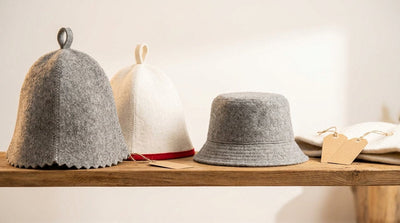
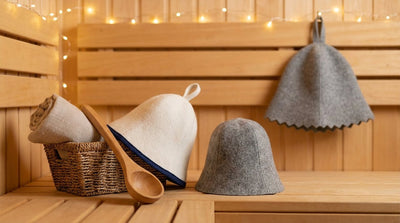
Sauna hats aren't a modern wellness gimmick. In Russian banya culture, the felt hat (often in that iconic bell shape) has been standard equipment for generations, right alongside the venik — the leafy birch or oak whisk used for massage. Finnish bathers have their own versions, and across Eastern Europe you'll find felt hats in shapes ranging from classic bells to brimmed bucket styles that shade the ears and neck a little extra. When steam pours push the perceived temperature way up, locals reach for their hats the way a cook reaches for oven mitts. The tradition survived because it works.
What You Might Notice When You Wear One
- Longer, more comfortable sessions. With your head buffered from the hottest air, many bathers find they can relax into the heat rather than counting down the seconds. (Comfort isn't a license to overdo it — hydrate, take breaks, and keep sessions sensible.)
- Happier hair. Shielding hair from direct dry heat may help it retain moisture, which is why hairdressers often suggest covering your hair in the sauna.
- Cooler ears and face. Especially with brimmed styles, that "my ears are on fire" moment mostly disappears.
- A calmer head. There's something almost meditative about it — the heat becomes a full-body experience instead of a head-first assault.
Quick Care Tips
Wool felt is low-maintenance, but a little care keeps a hat going for years:
- Let it air-dry fully after each session — hang it or set it on a shelf, away from direct flame or a scorching stove.
- Skip the washing machine. Hand-rinse in cool water with mild soap if needed, reshape, and air-dry.
- Don't wring or twist it; press water out gently so the felt keeps its shape.
Most quality sauna hats are one-size designs in shrink-resistant felt, so they'll hold their shape session after session with almost no fuss.
So, Do You Actually Need One?
Honestly? You can enjoy a sauna bareheaded — humans have for millennia. But if you've ever cut a session short because your head felt like it was baking while the rest of you was just getting started, the physics is firmly on the hat's side. It's a few ounces of wool doing quiet, effective work: slowing heat where you're most sensitive to it, protecting your hair and ears, and letting you settle deeper into the ritual. Once you try one, that funny felt hat stops looking like a joke and starts looking like what it's always been — very old, very good engineering.
Made for the hot room
DIVELUX sauna hats are handmade from 100% natural wool felt — breathable, insulating and built to last. 7 colors, classic and bucket styles, $19.99 with free US shipping.
Shop Sauna Hats →