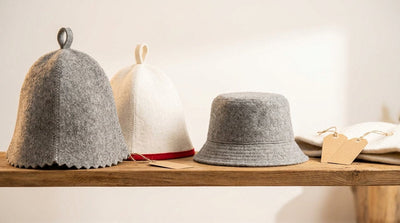
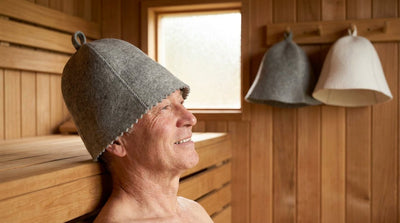
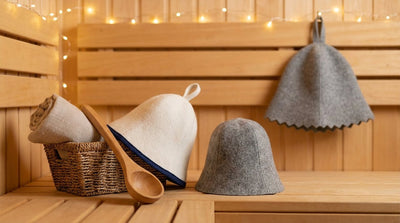
If you've ever seen someone in a sauna wearing what looks like a felted wizard hat, you've probably wondered: is that a genuine piece of heat-management equipment, or just a charming eccentricity? It's a fair question. Sauna hats look a little absurd — that's part of their appeal — but they've been standard gear in Russian banyas and Finnish saunas for generations. So let's do what a good sauna friend would do: sit down on the middle bench and look honestly at what a wool hat can and can't do for you.
The core idea: your head heats up faster than the rest of you
In a typical sauna, heat stratifies. The air near the ceiling can be 20–40°F hotter than the air at bench level, and your head — sitting at the top of your body, often closest to that hot layer — takes the brunt of it. Your scalp also has thin skin, lots of blood flow, and very little insulating fat, so it responds to heat quickly.
That's why many people tap out of a sauna session not because their body is done, but because their head feels done: flushed face, pounding temples, that slightly dizzy "okay, I'm cooked" feeling. The rest of you might have happily stayed another five minutes.
A sauna hat addresses exactly this mismatch. It doesn't cool you down — nothing in a 190°F room is cooling you down — but it slows how fast heat reaches your head, so your head and body warm up on a more even schedule.
Wait — a wool hat keeps you cooler? How?
This is the part that trips people up, because we associate wool with winter. But wool isn't "warm" — wool is an insulator. Insulation doesn't care which direction heat is flowing; it just slows it down.
In January, your body is warmer than the air, so a wool hat keeps heat in. In a sauna, the air is far hotter than your body, so the same wool slows heat moving inward. Thick felted wool traps millions of tiny air pockets, and still air is one of the poorest conductors of heat there is. It's the same physics as an oven mitt: the mitt isn't cold, it's just slow.
Wool has a second trick: it can absorb a surprising amount of moisture — up to roughly a third of its weight — without feeling soggy. That moisture buffering helps the hat stay comfortable through a long session instead of turning into a hot wet rag, which is why felted wool beats a damp towel draped over your head.
What the evidence actually says
Honesty time: nobody has run a large randomized controlled trial on sauna hats, and we shouldn't pretend otherwise. What we have is a mix of solid physics, well-documented physiology, and a few centuries of collective bathhouse experience. Here's how the common claims hold up:
| Claim | How well supported? | The honest take |
|---|---|---|
| Slows heat transfer to the head | Strong | Basic thermodynamics. Insulation slows heat flow in both directions — this isn't controversial. |
| Helps you sit longer, more comfortably | Good, mostly experiential | Widely reported by regular sauna-goers; consistent with head heat being a common limiting factor. May vary person to person. |
| Protects hair from heat damage | Good | Hair research shows high heat can dry the hair shaft and make it brittle. Shielding hair from the hottest air plausibly helps, especially for dry or color-treated hair. |
| Prevents overheating entirely | Weak — don't believe it | No hat makes overheating impossible. Your core still heats up. Listen to your body, hat or no hat. |
| Medical benefits (headache prevention, etc.) | Unproven | Some people report fewer post-sauna headaches. Plausible, but there's no clinical research. Treat it as a comfort tool, not a treatment. |
So: the mechanism is real, the comfort effect is consistently reported, and the wilder health claims you'll find elsewhere on the internet deserve a skeptical squint. Research on sauna bathing itself suggests promising things about cardiovascular health and relaxation — but the hat's job is narrower and humbler. It manages heat at head level. That's it, and that's plenty.
What a sauna hat realistically does for your session
- Evens out your heat-up. Your head stops being the first thing to overheat, so your session ends when your body says so, not your temples.
- Makes the top bench accessible. If you love the heat but can't handle the ceiling-level blast, a hat may be the difference between the top and bottom bench.
- Shields your hair. Dry sauna air may pull moisture from your hair; a wool sauna hat keeps the hottest air off it entirely. Your ears — which have thin, exposed skin that can genuinely sting in a hot sauna — get the same protection.
- Adds a little ritual. Not measurable, but real. Putting on the hat marks the start of the session, the way lacing up shoes marks the start of a run.
One thing it won't do: extend your session safely past your limits. If you feel dizzy, nauseous, or your heart is racing, that's your cue to leave — the hat doesn't overrule it. If you're still calibrating how long and how often to sit, our guide on finding your sauna frequency is a good companion read.
Getting the most out of one
Choose real felted wool
The insulation lives in the felt's trapped air, so material matters. Dense 100% wool felt insulates well and handles moisture gracefully; thin synthetic novelty hats mostly just look the part. Shape is personal preference — a classic bell covers ears and forehead generously, while a brimmed bucket style shades the face a bit more.
Wear it right
- Pull it down properly — over the ears and low on the forehead. Perched on top like a party hat, it's decoration.
- Wear it dry for maximum insulation — dry wool felt insulates your head best.
- Take it off between rounds so it can air out along with you.
- Let it dry naturally after your session. Never machine-wash felted wool unless you'd like a hat for a grapefruit.
And if you're sauna-ing in public rather than at home, don't worry about looking odd — in any serious sauna culture, the hat reads as "this person knows what they're doing." We've compared the two settings in public vs home sauna if you're weighing where to build your habit.
The verdict
Do sauna hats really work? For what they actually claim to do — yes. The physics of wool insulation is not in dispute, and the practical result, reported by sauna-goers from Helsinki to Houston, is a more comfortable head, protected hair, and sessions that end on your body's schedule rather than your scalp's. What they won't do is transform your health or make you heatproof, and anyone promising that is selling something other than felt.
The best evidence, honestly, is the cheapest to gather: wear one for a week of sessions, then forget it at home once. Most people notice the difference within the first five minutes on the top bench — right around the time their hatless neighbor starts eyeing the door.
Made for the hot room
DIVELUX sauna hats are handmade from 100% natural wool felt — breathable, insulating and built to last. 7 colors, classic and bucket styles, $19.99 with free US shipping.
Shop Sauna Hats →