There's a moment, about four seconds into a cold plunge, when your body stages a small mutiny. Your breath catches, your shoulders shoot up around your ears, and some ancient part of your brain begins drafting a strongly worded letter. Then — if you hold on and let the breath settle — something shifts. That swing between heat and cold is the whole point of contrast therapy, and it's the reason sauna-and-plunge culture has spread from Finnish lakes and Russian banyas to gyms and backyards across the US. Here's how to start without turning your first session into an endurance test.
What contrast therapy actually is
Contrast therapy just means deliberately alternating heat exposure with cold exposure. In sauna terms: you warm up in a hot room, you cool down fast in cold water, and you repeat. The Finns have done it for centuries — sauna, then the lake, then back again. The Russians alternate the banya with a bucket of ice water and are alarmingly cheerful about it.
Physiologically, the heat opens up your peripheral blood vessels and gets you sweating; the cold clamps them back down and shunts blood toward your core. Do that a few times and you've given your circulatory system a workout without moving much at all. Research suggests regular sauna bathing may be associated with cardiovascular and recovery benefits, and cold-water immersion appears to help with post-exercise muscle soreness — though the evidence is stronger for "feels good and may help" than for any specific medical promise. If you want a deeper dive into what the studies actually say, we went through them in What Science Says About Regular Sauna Use.
A beginner's session, step by step
You don't need a lake. A cold shower, a stock tank, or a gym plunge pool all work. Here's a first session that won't wreck you:
- Warm up dry. Rinse, towel off, and sit in the sauna for 8–12 minutes. Stop sooner if you feel dizzy or your heart is pounding uncomfortably.
- Cool off gradually. Step out, sit in fresh air for a minute, and let the initial sweat break.
- Go cold. 30 seconds to 2 minutes in cold water is plenty for a beginner. Get in slowly, keep your shoulders under if you can, and breathe out longer than you breathe in.
- Rest. Five to ten minutes of doing absolutely nothing. This part matters more than people think — it's where the "post-sauna glow" lives.
- Repeat 2–3 rounds, and finish however you like. Many people prefer to finish warm; some swear by ending cold. There's no wrong answer.
Rough numbers to aim for
| Element | Beginner | Experienced |
|---|---|---|
| Sauna round | 8–12 min | 15–20 min |
| Cold immersion | 30 sec–1 min | 2–3 min |
| Rest between | 5–10 min | 5–10 min |
| Rounds per session | 2 | 3–4 |
| Sessions per week | 1–2 | 3–4 |
These are starting points, not targets to beat. Contrast therapy is one of those practices where consistency beats heroics by a mile.
Why your head needs different treatment than your body
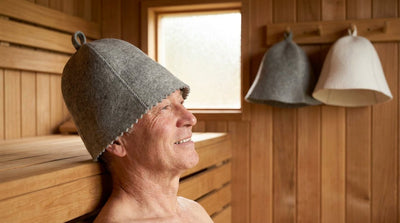
Here's the thing nobody tells beginners: your body and your head don't experience a sauna the same way. Heat rises, so at head level on the upper bench you're sitting in the hottest air in the room — often 20–30°F warmer than at your feet. Your scalp has thin skin, minimal fat, and a lot of blood flow close to the surface. It heats up fast, and an overheated head is usually what ends a session early. That lightheaded, "I need to get out now" feeling often shows up long before the rest of you is done.
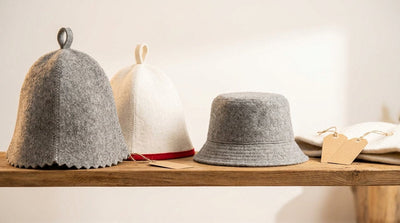
This is what a wool sauna hat solves. Natural wool felt is a genuinely excellent insulator — the crimped fibers trap air, and trapped air is what slows heat transfer. A hat keeps your scalp meaningfully cooler than the air around it, which usually means you can sit comfortably for a full round instead of tapping out at minute six. It also shields your hair from the dry heat that leaves it brittle and straw-like after a few months of regular sessions. Ours come in a classic bell shape and a brimmed bucket style — you can browse the sauna hats and pick whichever suits you, though a wool sauna hat in plain grey is the traditional starting point for a reason.
One practical note for contrast sessions specifically: take the hat off before you plunge, and leave it somewhere dry. Wool handles sweat well and dries out between rounds, but soaking it in the cold tub defeats the purpose — you'd be putting a wet, cold hat back on in a hot room, which is exactly backwards. If you're unsure about sizing before you buy, we broke that down in One Size Fits All? How a Sauna Hat Should Actually Fit.
Common beginner mistakes
- Going too cold, too long, too soon. Two minutes in near-freezing water is not more virtuous than thirty seconds. It's just colder.
- Holding your breath in the plunge. The gasp reflex is normal. Fight it with slow exhales, not by clenching everything.
- Skipping the rest phase. Bouncing straight from cold back into heat cuts short the part where your body actually adapts.
- Drinking nothing. You lose real fluid in a sauna. Water between rounds, not just after.
- Alcohol. Combining booze with heat and cold immersion is a genuinely bad idea — it impairs your ability to notice you're in trouble.
- Bare head on the top bench. See above. It's the easiest fix on this list.
Who should be careful
Contrast therapy is a big cardiovascular stimulus, and cold immersion in particular causes a sharp spike in heart rate and blood pressure. If you're pregnant, have a heart condition, have uncontrolled blood pressure, or take medication that affects your circulation or your ability to sense heat, talk to your doctor before starting — this is genuinely worth a conversation rather than a "probably fine." Never plunge alone in open water, and never in a home tub where you could lose consciousness unobserved. The cautious version of this practice is still the effective version.
What you actually need to get started
Not much, honestly. A towel to sit on, a second towel to dry off, water to drink, flip-flops for the walk between rooms, and a hat. Everything beyond that is preference — and we've sorted the genuinely useful from the merely marketed in The Complete Sauna Accessories Checklist.
If your setup is an infrared cabin rather than a traditional hot room, the calculus changes a little, since infrared heats you differently and the ambient air stays cooler. We looked at whether headwear still earns its place there in Do You Need a Sauna Hat in an Infrared Sauna?
Give it a month
The first few cold plunges are, frankly, unpleasant. The fourth or fifth is where most people stop dreading it and start noticing the aftermath instead — the loose shoulders, the clear head, the unreasonably good sleep that night. Start conservative, keep your head protected, rest properly between rounds, and let your tolerance build on its own schedule. It will.
Made for the hot room
DIVELUX sauna hats are handmade from 100% natural wool felt — breathable, insulating and built to last. 7 colors, classic and bucket styles, $19.99 with free US shipping.
Shop Sauna Hats →