Short answer: you can survive an infrared sauna without a hat — nobody's going to escort you out. But "do I need it" and "will I enjoy my session more with it" are two different questions, and the second one has a more interesting answer. Infrared saunas heat you differently than traditional ones, which changes what a sauna hat does for you — but doesn't make it useless. Let's walk through how infrared heat actually works, where a wool hat still earns its keep, and when you can honestly skip it.
First, a Quick Refresher: How Infrared Saunas Heat You
A traditional Finnish sauna (or a Russian banya — they're cousins, not twins) works by heating the air, usually to somewhere between 160°F and 200°F. That hot air then heats you, and because hot air rises, the fiercest heat collects right at head level. Your head ends up sitting in the hottest layer of the room while your feet lounge in the mildest one.
An infrared sauna flips the script. Instead of roasting the air, infrared panels emit radiant energy that warms your body directly. The air temperature stays much lower — typically 120°F to 150°F — even though you sweat plenty, because the heat is being delivered straight to your skin rather than through the air around you.
That one difference explains almost everything about the sauna hat question. In a traditional sauna, the hat's main job is shielding your head from a wall of superheated air. In an infrared sauna, that wall of air simply isn't as hot. So the hat's role shifts — from bodyguard to comfort upgrade.
What a Sauna Hat Does in a Traditional Sauna (and Why It's Different Here)
In a classic hot room, a thick wool hat is doing serious work:
- Insulating your head from air that can be 30–40 degrees hotter at bench-top level than at the floor
- Slowing how fast your head heats up, which may help you stay comfortable longer before you feel woozy or overheated
- Protecting your hair from dry, scorching air that can leave it brittle and parched
- Keeping your ears from stinging — anyone who's caught a fresh blast of steam knows exactly what we mean
In an infrared sauna, points one and four mostly fade away. The air isn't hot enough to sting your ears or bake your scalp from the outside. But points two and three? They're still very much in play — just for slightly different reasons.
Three Reasons a Sauna Hat Still Makes Sense in Infrared
1. Your head still heats up — just from the inside out
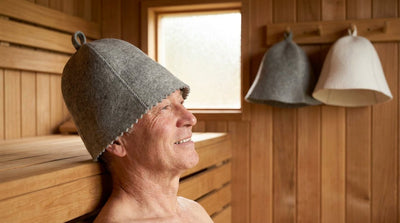
Infrared saunas raise your core body temperature; that's largely the point. And your head is one of the places you feel rising core temperature first. Many infrared users report the same familiar arc: comfortable, comfortable, comfortable, then suddenly flushed and lightheaded, and the session's over. A wool hat won't stop your core from warming (nothing should — that warming is where researchers think many of the potential benefits come from, as we cover in our look at the science of regular sauna use). What it may do is buffer the radiant heat and warm air reaching your scalp, so your head doesn't race ahead of the rest of your body. For plenty of people, that translates to a more even, less "why is my face on fire" kind of session.
2. Your hair still dries out
Here's the part almost nobody warns you about: 130°F air is still very dry air, and infrared panels are still radiating energy at your head for 30–45 minutes — often longer than a typical traditional sauna round. Heat strips moisture from hair regardless of how it's delivered. If you've noticed your hair feeling straw-like after a few weeks of regular infrared sessions, the sauna is a prime suspect. A felted wool hat acts like a breathable shield: wool is naturally moisture-regulating, so it protects your hair from direct heat without turning into a sweaty plastic bag situation the way a shower cap would.
3. Longer sessions reward better heat management
Infrared sessions tend to run long precisely because the air is gentler. But "gentler" isn't "gentle" — 40 minutes at 140°F is a real thermal load. The people most likely to appreciate a hat in an infrared sauna are the ones pushing longer sessions, sitting closest to the panels, or using higher-end units that climb toward 150°F+. If that's you, a wool sauna hat is one of the cheapest comfort upgrades you can make.
When You Can Honestly Skip It
We sell sauna hats, so take a moment to appreciate this section. You probably don't need one if:
- Your infrared sessions are short — 15 to 20 minutes at moderate settings
- Your unit runs on the cool end (many home units hover around 120–130°F)
- You have very short hair or a shaved head and no history of feeling head-heavy in the heat
- You're comfortable the whole way through and finish your sessions feeling great
If that's your situation, genuinely: carry on hatless. The sauna police will not be dispatched.
Traditional vs. Infrared: The Hat Math at a Glance
| Factor | Traditional Sauna | Infrared Sauna |
|---|---|---|
| Air temperature | 160–200°F | 120–150°F |
| How you're heated | Hot air (hottest at head level) | Radiant energy, direct to body |
| Head-overheating risk | High — hat strongly recommended | Moderate — hat helpful, especially in long sessions |
| Hair-drying risk | High | Real, thanks to longer session times |
| Verdict | Wear the hat | Optional, but many people are glad they did |
If You Do Wear One, Wool Is Still the Right Material
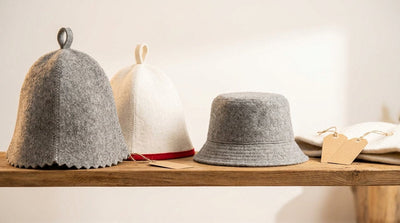
It's tempting to think a cooler sauna means any old beanie will do. Not quite. Cotton soaks up sweat and clings to your head like a damp towel. Synthetics trap heat and moisture against your scalp — the opposite of what you want. Felted wool remains the classic choice for good reasons:
- It insulates without suffocating. Wool's structure traps air, buffering heat while still letting your scalp breathe.
- It manages moisture. Wool can absorb a surprising amount of sweat before it ever feels wet.
- It stays comfortable session after session. Just air it out between uses and it's ready to go.
Fit matters more than people expect, too — a hat that's too snug defeats the airy insulation that makes wool work. We wrote a whole guide on how a sauna hat should actually fit if you want the details.
The Honest Bottom Line
In a traditional sauna, a wool hat is close to essential gear. In an infrared sauna, it's a comfort tool: less critical, still genuinely useful. If you run long sessions, sit close to the panels, care about your hair, or just find your head gets uncomfortably warm before the rest of you is ready to quit — a hat may help you settle in and stay longer. If none of that describes you, enjoy your hatless infrared glow with a clear conscience. Either way, now you're making the choice based on how infrared heat actually works, not on a rule someone taped to the sauna door.
Made for the hot room
DIVELUX sauna hats are handmade from 100% natural wool felt — breathable, insulating and built to last. 7 colors, classic and bucket styles, $19.99 with free US shipping.
Shop Sauna Hats →