Short answer: yes, you can wear a wool sauna hat in a steam room, and plenty of people do. The longer answer is more interesting, because a steam room asks something different of wool than a dry sauna does. At 100% humidity, the hat is no longer just a heat shield. It becomes a small, damp, surprisingly hardworking piece of felt sitting on your head. Here is what actually happens up there, and how to get the most out of it.
Steam room vs. sauna: two very different kinds of hot
A traditional Finnish-style sauna runs hot and dry, often 160 to 195°F (70 to 90°C) with humidity somewhere between 10 and 20 percent. A steam room is the opposite animal: usually 110 to 120°F (43 to 49°C), but the air is fully saturated with water vapor. Humidity sits at or near 100 percent.
That difference matters for your head. In a dry sauna, the danger is radiant and convective heat pouring down from the ceiling, where the hottest air collects. In a steam room, the temperature is lower, but wet air transfers heat to your skin far more efficiently than dry air does. Your sweat also cannot evaporate, because the air is already full. So the body's main cooling trick is switched off, and your head, with all its blood flow and thin skin, feels the warmth fast.
In other words, a steam room feels hotter than the thermometer says, and it has a way of sneaking up on you. Research suggests this is one reason people report feeling lightheaded in steam rooms at temperatures that would seem mild in a dry sauna.
What wool does when it gets wet
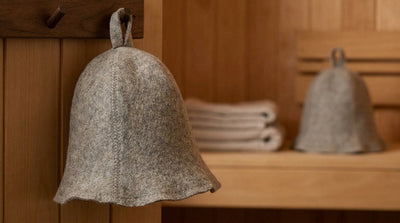
Wool felt is one of the few natural materials that keeps most of its insulating ability when damp. The fibers have a crimped structure that traps tiny pockets of air, and a wool fiber can absorb a meaningful amount of moisture into its core before it feels wet on the surface. A thick felted hat, like a wool sauna hat of the kind we make, does not collapse into a soggy towel the moment steam touches it. It stays lofty, and the trapped air keeps doing its job.
There is also a small, genuinely charming bit of chemistry here. When wool absorbs water vapor, the fibers release a little heat, a process textile scientists call the heat of sorption. In a cold, damp climate that is why wool socks feel warm even when wet. In a steam room, the effect is minor and short-lived, and it is not something you will notice. But it is a reminder that wool and humidity have a long, cooperative relationship.
What you will notice is the insulation. A wool hat slows the transfer of that heavy, wet heat into your scalp, so the sensation of "my head is cooking" arrives later, and often not at all in a 15-minute session.
So does a sauna hat actually help in a steam room?
It does, in a few specific ways:
- Slower head warming. Your head loses and gains heat quickly. Buffering it with an inch of felt means the rest of your body can enjoy the steam a bit longer before your head calls time.
- Less scalp discomfort. Hot condensation dripping from the ceiling onto your scalp is one of the least pleasant parts of a steam room. A hat catches it.
- Hair protection. Steam rooms are actually kinder to hair than dry saunas, since there is no dry heat pulling moisture out. But heat still opens the hair cuticle, and color-treated hair in particular may fade faster with repeated hot, wet exposure. A hat keeps things a few degrees calmer.
- A dry-ish spot for your ears. The ears are thin, sensitive, and the first part of the head to feel hot in wet air. A bell-shaped or brimmed hat covers them nicely.
What a sauna hat will not do is make a steam room safe to sit in indefinitely. Overheating is a whole-body event, and the hat only addresses one part. Listen to your body, keep sessions to a sensible length, and drink water. A hat is a comfort tool, not a license.
Bell or bucket for the steam room?
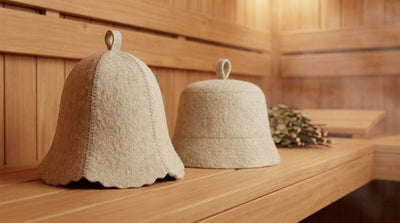
Both work. The classic bell shape gives you more air space above the crown, which is a small advantage in the heat department. The bucket shape has a brim that does a better job of shedding condensation drips off the ceiling and away from your face. If you sit under a drippy spot, the bucket wins. If you like to pull the hat down over your ears and forget about it, the bell is the cozier choice. We wrote up the trade-offs in detail in Bucket Sauna Hat vs Classic Bell Shape.
The practical stuff: wetting, drying, and smell
Should you wet the hat first?
In a dry sauna, some people soak the hat in cool water before going in, so it cools by evaporation. In a steam room, evaporation is off the table, so pre-wetting does less. A lightly damp hat is fine and a little refreshing on the way in. A dripping one just adds weight. If you want the cooling effect, dunk the hat in cold water between sessions instead, and put it back on before your next round.
Drying it afterwards
This is where steam room use differs most from sauna use. A hat that has spent 20 minutes in 100 percent humidity comes out genuinely damp, and damp wool that sits crumpled in a gym bag is the fastest route to a musty hat. The routine is simple:
- Squeeze gently, do not wring. Wringing stresses the felt and can distort the shape.
- Reshape it on your hand or over a bowl.
- Air dry away from direct heat. A radiator or dryer can shrink and stiffen it.
- Store it only once it is fully dry.
Done consistently, a hat will shrug off years of steam room visits. We cover the full care routine, and what realistically wears a hat out, in How Long Does a Wool Sauna Hat Last?
The odor question
Wool has natural antimicrobial properties, and lanolin residue in the fibers helps it resist odors far better than cotton or synthetic fleece. Steam rooms, though, are the ultimate stress test: warm, wet, and shared with other warm, wet people. If your hat starts to smell, a hand wash in cool water with a little wool detergent, followed by the air-dry routine above, resets it. Avoid hot water, which felts the wool further and can shrink it.
A quick comparison
| Condition | Dry sauna | Steam room |
|---|---|---|
| Typical temperature | 160–195°F | 110–120°F |
| Humidity | 10–20% | ~100% |
| Main threat to your head | Radiant heat from above, dry hair | Fast wet-heat transfer, dripping condensation |
| What the hat does | Insulates, keeps hair from drying | Insulates, catches drips, protects ears |
| Hat condition after | Warm, mostly dry | Noticeably damp, needs proper drying |
| Pre-wetting useful? | Yes, cools by evaporation | Marginal, dunk between rounds instead |
Does material quality matter more in steam?
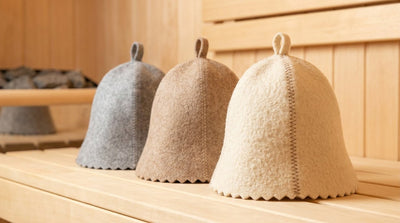
Yes, and this is worth being honest about. Thin, loosely felted hats, the kind that go for a few dollars less, tend to absorb water quickly, sag, and lose loft. In a dry sauna you may barely notice. In a steam room, a thin hat can end up plastered to your head like a wet dishcloth, which defeats the purpose. Dense, properly felted wool holds its shape, keeps its air pockets, and dries back to the same silhouette. If you are choosing a hat mainly for steam rooms, that thickness is the single most useful thing to pay for, as we argued in Cheap vs Expensive Sauna Hats.
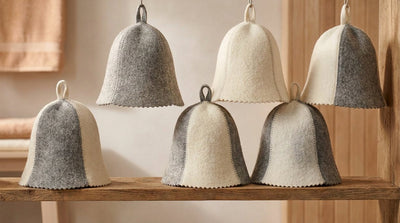
One more thing on color: in a steam room, lighter hats show water spots and any stray mineral streaks from condensation more readily. They also dry a bit lighter and brighter. Neither is a problem, just a matter of taste.
Steam room etiquette with a hat on
You will occasionally get a curious look. Sauna hats are common in Russian banyas and Finnish saunas, but still a novelty in many American gym steam rooms. Wear it anyway. The people who ask are usually the ones who leave the room five minutes later with a pink forehead, and a surprising number of them go home and order one. Sit or lie with your head lower rather than higher, keep sessions to 10 to 20 minutes, cool off between rounds, and drink plenty of water. The hat makes the whole thing more comfortable; the rest is still up to you.