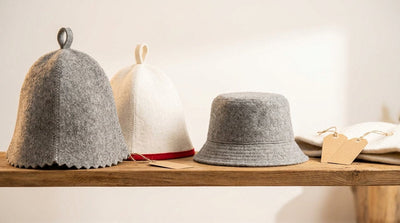
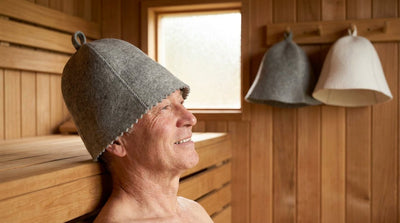
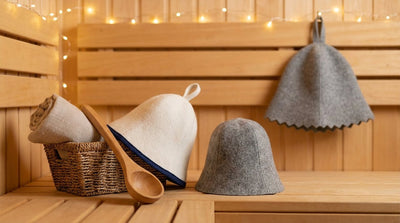
Walk down any online marketplace and you'll find sauna hats made of everything from polyester fleece to mystery "felt blend." Many of them borrow the words "natural wool" for the product title, and some of them are stretching the truth like a cheap acrylic beanie. So let's slow down and unpack what "100% natural wool" actually means — where the fiber comes from, how it becomes felt, and why, once you're sitting in 180°F heat, the difference between real wool and a look-alike stops being a labeling technicality and starts being something you can feel on your head.
First, the label: what "100% natural wool" actually promises
In textile terms, "wool" refers to fiber shorn from sheep (and sometimes close cousins like lambswool or merino, which are still sheep's wool — just from specific breeds or shearings). "100% natural" means exactly what it sounds like: the material is entirely that animal fiber, with no synthetic fibers blended in and no plastic content hiding in the mix.
That last part matters more than you'd think, because blending is where most corner-cutting happens. A hat that's 60% wool and 40% polyester can still legally shout "wool!" on the listing page. It will look nearly identical in photos. It will not behave identically in a hot room — more on that in a moment.
A genuinely all-wool hat has a few telltale traits:
- It's slightly irregular. Natural fiber varies in texture and thickness. Handmade wool felt has character — tiny flecks, subtle variations in surface — rather than the eerie uniformity of machine-extruded synthetics.
- It smells like wool when damp. Faintly earthy, a little like a sweater in the rain. Polyester smells like nothing, or worse, like warm plastic.
- It doesn't melt. Wool chars and self-extinguishes; synthetics soften and melt. (Please don't test this on your hat — but it's why wool has been used in firefighting gear and military uniforms for generations.)
From sheep to felt: no weaving required
Here's a fun bit of material science: wool felt isn't woven or knitted at all. Each wool fiber is covered in microscopic overlapping scales, like shingles on a roof. When you apply moisture, heat, and friction — the traditional felting process — those scales lock together permanently, and the loose fluff becomes a dense, stable mat of interlocked fiber.
Humans figured this out thousands of years ago, and it's still how a proper sauna hat is made today. Sheets of carded wool are shaped, wetted, and worked by hand until they hold their form — no glue, no stitched seams doing structural work, no synthetic binder. The result is a material that's simultaneously thick, lightweight, and full of tiny air pockets. Those air pockets are the entire secret to why the hat works.
Why wool earns its keep in the sauna
A sauna hat looks like a joke the first time you see one — a wooly hat, in the hottest room you'll voluntarily enter? But the logic is the same reason a thermos keeps coffee hot and lemonade cold: insulation doesn't add heat or cold, it slows the transfer of heat. Three properties of natural wool do the heavy lifting.
1. Trapped air is a terrible conductor (in a good way)
Felted wool is mostly air by volume, held in place by that dense fiber matrix. Still air is one of the best insulators around, so the felt creates a buffer between the sauna's hottest layer of air — which collects right at head level, where you're sitting — and your scalp. Your head stays noticeably cooler, which many sauna-goers find lets them sit comfortably a bit longer. If you've read our piece on steam rooms versus saunas, you'll remember that head-level heat is the intense part of the experience; the hat is aimed squarely at that.
2. Wool manages moisture instead of soaking it up
Wool fibers can absorb a meaningful amount of water vapor into their core while the surface stays relatively dry to the touch. In practice, that means the hat breathes: sweat and steam don't turn it into a soggy, clingy layer the way they would with cotton. Synthetics go the other direction — they absorb almost nothing, so moisture just sits against your skin and, once the fabric heats up, so does everything under it.
3. It's kind to your hair
Dry sauna heat may draw moisture out of hair, leaving it brittle over time — anyone with color-treated or curly hair knows the feeling. A wool layer shields hair from the most direct heat, and because the fiber breathes, you're not trading dryness for a sweaty greenhouse. It's a simple, no-product way to look after your hair while you relax. (If you're just getting started, our first sauna session guide covers hair and skin care alongside everything else.)
Wool vs. the imposters: a quick comparison
| Property | 100% wool felt | Synthetic "felt" | Cotton |
|---|---|---|---|
| Insulation when damp | Stays effective | Fair, but traps heat against skin | Poor — soaks through quickly |
| Breathability | Excellent | Low | Moderate |
| Behavior in high heat | Stable; naturally flame-resistant | Can soften, off-gas, or feel "plasticky" | Stable but ineffective once wet |
| Odor over time | Naturally odor-resistant | Holds onto smells | Mildew-prone if stored damp |
| Biodegradable | Yes | No — it's plastic | Yes |
None of this makes synthetic hats dangerous, to be clear — but they're solving the problem with the wrong material. Wool evolved over millennia to regulate a warm-blooded animal's temperature in wildly variable conditions. Polyester evolved to be cheap.
How to read a listing like a pro
When you're shopping — for a hat from us or anyone else — a minute of label-reading saves you from the blend trap:
- Look for a percentage. "100% wool" or "100% natural wool felt" is a specific claim. "Wool blend," "wool-feel," or just "felt" with no fiber listed usually means synthetics are along for the ride.
- Check the construction. Genuine felted hats are seamless or minimally stitched; a hat sewn from thin printed fabric panels is almost certainly not traditional felt.
- Mind the thickness. A sauna hat needs real loft to insulate. Paper-thin material — wool or not — won't buffer much heat.
- Handmade is a feature, not a flaw. Slight asymmetry and surface texture are signs of hand-felting, which generally produces denser, longer-lasting felt than mass production.
Every DIVELUX wool sauna hat is hand-felted from 100% natural wool, which is why no two are perfectly identical — and why yours will hold its shape through years of steam.
Caring for real wool (it's easier than you think)
Because felt is naturally odor-resistant and doesn't cling to sweat, care is refreshingly minimal:
- After each session, shake it out and let it air-dry on a shelf or hook — never on a radiator or in a dryer, which can shrink and distort the felt.
- Spot-clean with cool water and a drop of mild soap if needed; skip the washing machine entirely.
- Store it dry and loosely shaped. Wool's natural resilience will do the rest.
Treated this way, a well-made wool hat outlasts several synthetic replacements — one more quiet argument for the real thing. And if you're rounding out the rest of your kit, our sauna accessories checklist sorts the genuinely useful gear from the gimmicks.
The honest bottom line
"100% natural wool" isn't marketing poetry — it's a materials claim with real consequences in a hot room. Real wool insulates your head where the heat is fiercest, breathes instead of trapping sweat, may help protect your hair from drying out, and does it all with a fiber that's renewable and biodegradable. Research on sauna comfort is still catching up to what bathhouse traditions have practiced for centuries, but the physics of insulation aren't controversial: trap still air next to your head, and the heat has to work a lot harder to get to you. Sheep figured that out long before we did. We're just borrowing the idea.
Made for the hot room
DIVELUX sauna hats are handmade from 100% natural wool felt — breathable, insulating and built to last. 7 colors, classic and bucket styles, $19.99 with free US shipping.
Shop Sauna Hats →