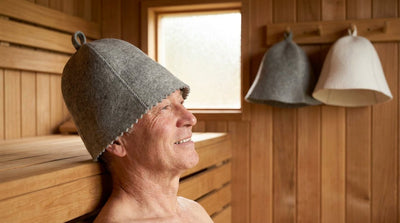
Walk into a Finnish sauna and the air bites — dry, sharp, hot enough to make your ears tingle before you've even sat down. Walk into a steam room and it's the opposite: a warm, wet fog that wraps around you like a damp towel. Both leave you pink and blissed out. But physically, they're doing very different things to your body — and that difference matters a lot for the one part of you that tends to suffer first: your head.
The short version: dry heat vs wet heat
A traditional sauna heats the air to a high temperature and keeps humidity low. A steam room keeps the temperature much lower but saturates the air with water vapor until it can't hold any more. Your skin reads both as "hot," but the mechanism is different, and so is the ceiling on how hot the room can safely get.
| Traditional (Finnish) sauna | Steam room / hammam | |
|---|---|---|
| Air temperature | 150–195°F (65–90°C) | 105–120°F (40–49°C) |
| Relative humidity | ~10–20% (higher briefly after löyly) | ~100% |
| Heat source | Stove with rocks; wood, electric | Steam generator |
| Surfaces | Wood benches, dry to the touch | Tile or stone, always wet |
| Sweat behavior | Evaporates fast | Barely evaporates — condensation adds to it |
| Typical session | 8–15 minutes per round | 10–20 minutes per round |
That last row surprises people. How can a 115°F room feel as demanding as a 185°F one? Because your main cooling system is evaporation. In dry air, sweat flashes off your skin and carries heat with it. In saturated air, it has nowhere to go — it just sits there, pooling. So a steam room can load your body meaningfully even though the thermometer looks gentle.
Why heat stratifies (and why your head takes the hit)
Hot air rises. In a sauna, that means the temperature at the top bench near your head can be dramatically higher than at your feet — a gap of 30°F or more between ankle level and scalp level is completely normal in a well-heated room. You sit down, your feet feel pleasant, and meanwhile your scalp and ears are parked in the hottest air in the building.
Then there's radiant heat. A sauna stove doesn't only warm the air — the rocks and metal radiate directly at whatever's in line of sight. If you're seated high and close, your head is catching that radiation head-on. Ears are especially vulnerable: thin skin, cartilage, not much blood flow to carry heat away. They're usually the first thing to sting.
Steam rooms stratify too, but less severely, and there's no glowing stove radiating at your face. The heat is gentler and more evenly distributed. This is genuinely relevant to the hat question — more on that in a second.
What each one does to your hair and skin
Dry sauna heat pulls moisture out of everything, hair included. Hair is a protein fiber, and prolonged high heat can degrade the cuticle — the protective outer layer — leaving strands rougher, more porous, and more prone to breakage. Color-treated and bleached hair, where the cuticle is already compromised, tends to show it fastest. Anyone who's gone from a sauna habit to noticing frizz they didn't have before knows this feeling.
Steam rooms are kinder to hair in one sense — there's no dehydration happening — but hair swells when it absorbs water, and swollen hair is more fragile. Rough-drying or brushing it aggressively afterward does more damage than the room ever did.
For skin, research suggests regular sauna bathing is associated with cardiovascular benefits and improved sleep quality in observational studies, though causation is hard to pin down and individual results vary a lot. What's less debatable is the immediate stuff: overheating feels awful, and dizziness on standing is common. Neither room is a medical treatment, and if you're pregnant, have heart conditions, or take blood-pressure medication, this is a conversation for your doctor, not a blog.
The head-protection question, answered honestly
Here's where we'll be straight with you, even though we sell hats.
In a dry sauna, a wool felt hat earns its place. Wool is a genuinely good insulator — the crimped fibers trap air, and trapped air is what slows heat transfer. A hat sitting between your scalp and 190°F air (plus stove radiation) buys you a meaningful buffer. In practice that means your ears stop stinging, your head stops being the reason you leave, and you can sit through a full round comfortably rather than tapping out early. It also shields hair from the direct dry heat. This is why Finnish and Russian bathhouses have used felt hats for generations — it's not folklore, it's insulation.
In a steam room, a wool hat is far less useful. The ambient temperature is much lower, there's no radiant stove, and wool in 100% humidity gets damp. Wet fibers conduct heat better than dry ones, so a soggy hat loses much of its insulating advantage. It also won't dry out between rounds in that environment. We'd rather tell you to leave the hat in your bag than sell you on something that won't do much.
So: hat for the dry sauna, skip it for the steam room. If your gym has both and you alternate, a wool sauna hat is worth bringing — just keep it out of the steam. The same reasoning applies to infrared cabins, which are their own case; we covered that in Do You Need a Sauna Hat in an Infrared Sauna?
Caring for a felt hat either way
- Wear it dry — dry wool felt insulates your head best.
- Hang it somewhere airy afterward. Never a radiator, never a dryer; heat shrinks and felts wool further.
- Hand-wash cool with mild soap, press water out, reshape flat. Don't wring it.
- If it's been in a steam room, it'll need real drying time before its next use.
Choosing between them — and using both well
- Want intensity and ritual? Dry sauna. Higher heat, löyly on the rocks, the whole ceremony. Bring a hat and a towel to sit on.
- Congested, or you find dry heat harsh on your throat? Steam room. Many people find the humidity easier on the airways, though evidence for treating respiratory conditions is thin.
- Sensitive or dry skin? Steam tends to feel gentler; dry heat can leave skin tight without a good moisturizer afterward.
- Doing contrast work with cold? Dry sauna pairs better with a plunge — the temperature swing is bigger and the transition cleaner. Our contrast therapy guide walks through the sequencing.
Whichever you pick, the fundamentals don't change: hydrate before and after, sit lower if the top bench is too much, leave when your body says so rather than when the timer says so, and cool down gradually instead of bolting for the door. If you're still building your kit, our accessories checklist sorts the genuinely useful from the merchandise — and if this is all new, start with Your First Sauna Session.
Made for the hot room
DIVELUX sauna hats are handmade from 100% natural wool felt — breathable, insulating and built to last. 7 colors, classic and bucket styles, $19.99 with free US shipping.
Shop Sauna Hats →