You love the sauna. Your hair… has questions. If you've ever stepped out of a good long session and noticed your hair feeling like straw — dry, frizzy, a little crunchy at the ends — you're not imagining it. Heat is wonderful for tired muscles and a busy mind, but it's not automatically kind to the strands on your head. The good news: sauna hair damage is real but very preventable, and the fixes are simple enough that people have been using one of them for a few hundred years.
What sauna heat actually does to hair
Hair is mostly keratin, a protein, wrapped in an outer layer of overlapping scales called the cuticle. Healthy hair also holds a surprising amount of water — that internal moisture is a big part of what keeps it flexible and shiny instead of brittle and dull.
Now put that structure in a room that's 170–200°F (or hotter, if your sauna friends are enthusiasts). A few things tend to happen:
- Moisture loss. Dry heat pulls water out of the hair shaft. Hair that loses too much internal moisture becomes stiff and prone to snapping — the same reason blow-drying on high with no protection roughs hair up over time.
- Cuticle stress. Heat can lift and roughen those protective scales. A raised cuticle scatters light (hello, dullness) and snags against neighboring strands (hello, frizz and tangles).
- Scalp dryness. Your scalp is skin, and dry heat can leave it feeling tight or flaky, especially if you sauna often.
- Color fading. If you color your hair, repeated heat exposure may speed up fading, since dye molecules sit in a structure that heat is actively disturbing.
To be fair to the sauna: research on this is thinner than you'd expect, and a single 15-minute session is unlikely to wreck anyone's hair. The concern is cumulative. If you sauna two or three times a week, every week — the way sauna is meant to be enjoyed — those small stresses add up. And here's the twist most people don't realize: your head sits in the hottest part of the room. Heat rises, so in a typical sauna the temperature at head height can be dramatically higher than at your feet. Your hair is getting the harshest dose of the whole experience.
The short version: the hottest air in any sauna sits at head height. A thick 100% wool sauna hat insulates your head and hair so you can stay on the bench longer — DIVELUX hats are handmade wool felt, $19.99 with free US shipping.
Wet hair, dry hair, and the steam question
A common bit of sauna folklore says wet hair is protected hair. It's actually closer to the opposite. Wet hair is more fragile than dry hair — water swells the shaft and softens the keratin, making it easier to stretch and break. And in a hot room, the water clinging to your hair heats up fast; some hairdressers argue that hot water in the hair can stress the cuticle more than dry heat alone. So walking into the sauna with a soaking head isn't the protective move it seems.
Steam rooms and steam-heavy banya sessions are a slightly different animal — the humidity means your hair isn't losing moisture as aggressively — but the heat-at-head-height problem remains, and drenched hair is still fragile hair. Either way, the practical advice converges on the same place: keep the heat off your head in the first place.
The old-school fix that still beats everything else
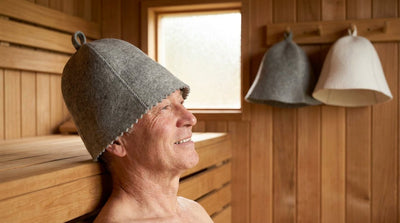
Bathers in the Russian banya figured this out generations ago, long before anyone could explain cuticles: cover your head with wool felt. A proper wool sauna hat works because wool is a genuinely remarkable insulator — the felted fibers trap a layer of air around your head, so the air next to your scalp and hair stays dramatically cooler than the air in the room. Your body still sweats and gets the full sauna experience; your head just opts out of the broiler.
That insulation does double duty. It keeps your hair out of the harshest heat, and it helps keep your head from overheating — which is often the real reason people cut sessions short. Many sauna-goers find they can sit longer and more comfortably in a hat, dizziness-free, which is a nice bonus on top of the hair protection. (If you're curious how a piece of felt became standard equipment from Moscow to Helsinki, we wrote about it in our short history of the sauna hat.)
One caveat: material matters. A synthetic hat can trap heat against your head rather than insulating you from it, and some synthetics get unpleasantly hot to the touch in a sauna. Natural wool felt breathes, wicks moisture, and insulates even when damp — we break down the differences in wool vs synthetic sauna hats if you want the full comparison.
A simple hair-protection routine for sauna day
Here's the whole routine — it takes about two minutes:
- Start with dry or lightly damp hair. If your hair is wet from a shower, give it a quick towel-dry before you head in. No dripping.
- Skip the styling products. Heat plus hairspray or gel is not a combination your hair enjoys. Clean(ish) hair goes in the sauna.
- Optional: add a light conditioning layer. A few drops of hair oil or a dab of leave-in conditioner, especially on the ends, gives dry or color-treated hair extra buffer. Some people treat sauna time as deep-conditioning time — a mask under the hat, rinsed out after. Your call.
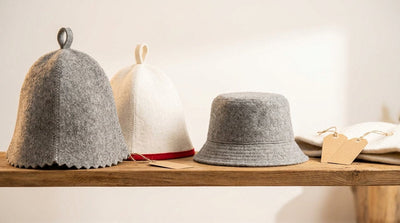
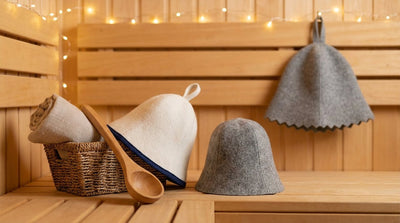
- Put the hat on. Tuck long hair up inside it so the ends aren't hanging out in the hot air. A bell-style hat covers ears and more length; a brimmed bucket style shades the face a bit more — here's how to pick between them.
- Rinse cool afterward. Finish with a cool or lukewarm rinse rather than a hot one. It's refreshing, and it avoids piling more heat onto hair that just spent time in a hot room.
- Rehydrate — you and your hair. Drink water, and if you sauna often, work a conditioning treatment into your weekly routine.
Quick reference: what helps vs. what hurts
| Helps your hair | Hurts your hair |
|---|---|
| Wool felt hat, hair tucked in | Bare head at top-bench temperatures |
| Dry or towel-dried hair going in | Soaking-wet hair in dry heat |
| Light oil or leave-in on the ends | Styling products baking in the heat |
| Cool rinse after the session | Hot shower immediately after |
So — does the sauna damage your hair?
Honest answer: it can, gradually, if you give it a bare head to work on several times a week. But the dose makes the poison, and the fix is almost comically low-tech. Keep your hair dry-ish, keep products out of it, and put a wool hat between your head and the heat. Do that, and there's no reason your hair habit and your sauna habit can't coexist happily for decades — which, not coincidentally, is roughly how long a well-kept felt hat lasts. (Speaking of which: here's how to care for a wool sauna hat so it stays in the rotation for years.)
Your muscles get the heat. Your mind gets the quiet. Your hair gets a cozy little wool roof. Everybody wins.
Made for the hot room
DIVELUX sauna hats are handmade from 100% natural wool felt — breathable, insulating and built to last. 7 colors, classic and bucket styles, $19.99 with free US shipping.
Shop Sauna Hats →