Ask ten sauna people whether infrared "counts" and you'll get twelve opinions, at least one of them shouted. The truth is less dramatic: infrared cabins and traditional hot rooms are two different tools that happen to share a bench. One warms you from the inside out at gentle air temperatures; the other heats the room until the room heats you. Both can feel wonderful. Neither is a scam. Here's an honest look at how they differ, what the research actually supports, and which one deserves your Tuesday evening.
How each one actually heats you
A traditional sauna — Finnish, Russian banya, or the cedar box at your gym — heats air and rocks. The stove pushes the room to somewhere between 160°F and 200°F (roughly 70–95°C), and that scorching air, plus radiant heat off the stones and walls, raises your skin temperature fast. Your body responds by dumping heat the only way it can: sweat, dilated vessels, a climbing heart rate. Throw water on the rocks and you add löyly, the burst of steam that makes the same air temperature feel dramatically hotter.
An infrared cabin skips the air almost entirely. Its emitters radiate in the infrared band, and that energy is absorbed by your skin and the tissue just beneath it. The air might sit at a mild 120–140°F (about 50–60°C) — cool enough to breathe comfortably, read a book, hold a conversation without sounding like you're being interrogated. You still sweat, often a lot, but the room around you never becomes hostile.
The practical upshot: traditional saunas deliver a bigger thermal shock in less time. Infrared delivers a slower, gentler build that many people can tolerate for longer.
Side by side
| Traditional | Infrared | |
|---|---|---|
| Air temperature | 160–200°F | 120–140°F |
| Typical session | 8–20 min per round | 20–45 min |
| Humidity control | Yes — water on rocks | Essentially none |
| Warm-up time | 30–50 min | 10–15 min |
| Power draw | Higher | Lower |
| Home install | Often needs 240V, venting, clearances | Frequently plugs into a standard outlet |
| Social feel | Communal, ritualistic | Solo, quiet, spa-like |
| Venik / löyly possible | Yes | No |
What the research actually suggests
Here's where honesty matters more than enthusiasm. The bulk of the long-term sauna research — the Finnish cohort studies people love to cite about cardiovascular outcomes and mortality — was done on traditional saunas, over decades, in a population that bathes several times a week. Those studies are observational, which means they show association, not proof of cause, and they don't automatically transfer to a different heating method.
Infrared has a smaller evidence base: mostly short trials with modest sample sizes. Research suggests infrared sessions may produce short-term improvements in blood pressure, vascular function, and perceived recovery after exercise, and some work on far-infrared has looked at chronic pain and stiffness with cautiously encouraging results. Promising? Yes. Settled? Not remotely.
A few claims worth deflating gently:
- "Infrared detoxes you." Sweat is overwhelmingly water and electrolytes. Your liver and kidneys handle detoxification, and they don't need a cabin's help.
- "Sweating more means it's working better." Sweat volume tracks heat load and hydration, not benefit. A puddle on the bench is not a scoreboard.
- "You'll lose weight." You'll lose water, and you'll get it back at the first glass. Any real metabolic effect is small.
Whatever you sweat out, put back. Our guide to what to drink before, during and after the sauna covers the electrolyte side, which matters more in long infrared sessions than most people expect — you're often in there twice as long.
How they feel, which is the part nobody measures
Traditional
Intense, elemental, a little confrontational in the best way. There's a rhythm to it: heat, cool, rest, repeat. The steam hits, everyone goes quiet, someone eventually says "one more?" It's a practice with culture attached — benches, ladles, the venik if you're in a banya. The heat is unevenly distributed, too, which is why the top bench is a commitment and why your head and ears take the worst of it.
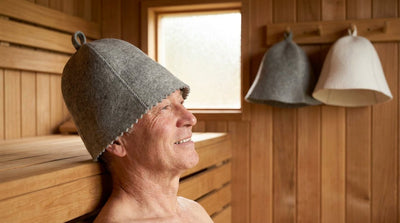
That last point is the practical case for a hat. In a 190°F room the air near the ceiling is hottest, your scalp has thin skin and lots of blood flow, and it's usually your head — not your body — that taps out first. A wool sauna hat insulates the head so you can stay for the full round in comfort, and it keeps dry heat from stripping moisture out of your hair. In an infrared cabin at 130°F, honestly, you don't need one; the heat load simply isn't there. If you split your time between the two, you'll reach for it in the traditional room and leave it on the hook for infrared.
Infrared
Quieter, more private, easier to build a habit around. You can podcast your way through 35 minutes without feeling like you're enduring anything. For people who find traditional heat overwhelming — beginners, those sensitive to hot air, anyone with breathing discomfort in steam — infrared is often the version they'll actually use twice a week. And a routine you keep beats a ritual you admire from a distance.
Choosing between them
- You want the cultural experience, steam, and social heat. Traditional, no contest. Infrared can't do löyly.
- You're installing at home in a condo with standard wiring. Infrared, usually — lower power draw, faster warm-up, simpler install.
- You're chasing the cardiovascular research specifically. Traditional matches the study conditions more closely. That's not a guarantee of outcomes, just a better match.
- Hot air makes you miserable. Infrared. Sweating comfortably beats not going.
- You want to unwind before bed. Either works — the mechanism is the post-sauna cooldown that drops core temperature, which we unpack in evening sauna and sleep. Finish 60–90 minutes before lights out.
A sane starting protocol for each
Traditional: 10–15 minutes, cool down completely, repeat two or three times. Sit low on your first visit. Hydrate between rounds. Cover your head if the top bench is where you want to be.
Infrared: Start at 20 minutes and work toward 30–40 as tolerated. Bring water in with you — the sessions are long. Expect a slower, deeper warmth rather than a slap of heat.
For both: leave when your body says leave, not when the timer says so. And if you're using a public facility, the unwritten rules are worth knowing — sauna etiquette in American gyms and spas covers the towel-and-shower basics that keep everyone comfortable.
The honest verdict
If we had to pick one for a lifetime, we'd take the traditional sauna — the evidence base is deeper, the sensory experience is richer, and steam is genuinely irreplaceable. But "better" is the wrong frame. Infrared is the more accessible entry point, the easier home install, and the one plenty of people will realistically use more often. The best sauna is the one you're sitting in this week. Anyone who tells you otherwise probably hasn't tried both.
Made for the hot room
DIVELUX sauna hats are handmade from 100% natural wool felt — breathable, insulating and built to last. 7 colors, classic and bucket styles, $19.99 with free US shipping.
Shop Sauna Hats →