Ask ten sauna regulars how thick a sauna hat should be and you'll get ten confident answers, most of them wrong in opposite directions. Some swear by a thin, floppy felt; others want something you could stop a hockey puck with. The truth sits in the middle, and it has less to do with millimeters than with how the wool was felted. Here's what density actually does for you in the heat, how to judge it with your hands, and where the sweet spot lies.
Why thickness matters at all
A sauna hat has one real job: slow down the transfer of heat from the air to your head. In a Finnish-style sauna the air near the ceiling can sit around 80 to 100 °C, and your head is the part of you closest to it. Wool felt works because it's mostly trapped air. The fibers are matted into a tangle that holds thousands of tiny pockets of still air, and still air is a surprisingly poor conductor of heat.
So a thicker hat means more trapped air, which means more insulation. Simple, right? Mostly. Past a certain point, extra thickness stops helping much and starts costing you in other ways: weight, stiffness, poor fit and, oddly, sweat management. A hat that's too dense can't let moisture out, so your scalp ends up sitting in a warm, damp cap. That's the opposite of what you wanted.
Density versus thickness: they're not the same thing
This is the part most buyers miss. Two hats can both measure 4 mm thick and behave completely differently in the sauna, because one is densely felted and the other is loose and airy.
- Thickness is simply how far the felt stands off your head. Easy to measure with a ruler.
- Density is how tightly the fibers are locked together. It's measured in grams per square meter (gsm) in the trade, but you mostly feel it as firmness.
Loose, low-density felt is thick but weak. It insulates well for a few sessions, then compresses, sags and thins out wherever it's been handled. Very high-density felt holds its shape beautifully but tends to feel like cardboard and traps sweat. Good sauna felt is somewhere in between: firm enough to hold a bell or brim shape on its own, soft enough to flex when you squeeze it.
The practical range
After handling a lot of hats, here's how the common thicknesses break down. Treat these as ballpark figures; felt is a natural material and no two batches are identical.
| Felt thickness | Typical density | How it behaves in the sauna |
|---|---|---|
| Under 2.5 mm | Low (often synthetic blend) | Barely noticeable insulation. Ears and crown get hot fast. Loses shape after a handful of washes. |
| 3 to 5 mm | Medium to firm | The sweet spot. Real insulation, breathable, holds its shape, dries overnight. |
| 6 to 8 mm | Very firm | Excellent insulation but heavy and stiff. Can feel sweaty. Slow to dry, so it may smell if you use it daily. |
| Over 8 mm | Industrial | Overkill. Mostly seen in novelty or ceremonial hats. Fine for a photo, not for a long session. |
Most well-made hats, including our own wool sauna hat, land in that 3 to 5 mm band with a firm hand-felted density. That's not a coincidence. It's roughly where the insulation curve flattens out and the comfort curve starts dropping.
Three quick hand tests for density
You don't need a lab. If you can hold the hat, you can judge it in about thirty seconds.
- The pinch. Squeeze a patch of felt between thumb and forefinger. Good sauna felt compresses slightly and springs back. If it flattens to nearly nothing, it's too loose. If it doesn't give at all, it's too dense.
- The light test. Hold the hat up to a window. Firm felt blocks light almost completely. If you can see a bright glow or actual pinholes, the fibers aren't locked tight enough to insulate consistently.
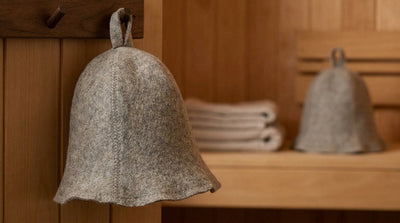
- The stand-up test. Set the hat on a table. A properly felted bell or bucket shape stands on its own without slumping. A hat that collapses is relying on your head to give it structure, and it'll do the same in the heat.
These same tests also help catch synthetic blends that are dyed and textured to look like wool. If you want to go further, our guide on how to spot fake wool felt covers the burn and smell tests too.
Why hand-felted density tends to win
Machine-made felt is rolled out in flat sheets at a fixed thickness, then cut and sewn into a hat shape. That's efficient, but seams create thin spots and the felt is often engineered to be as thin as the factory can get away with. Hand felting works differently: wet wool is shaped and worked directly into a three-dimensional form, and the maker keeps agitating it until it firms up. The result is seamless, slightly thicker at the crown where it matters and naturally consistent in density because there's a human checking it as it shrinks.
That's also why a good handmade hat costs more than a $10 multipack. If you're curious how the pricing breaks down, we wrote an honest look at how much a sauna hat should cost.
Does thicker felt protect your hair better?
A little, but the mechanism isn't what people expect. Hair damage in the sauna mostly comes from dry heat pulling moisture out of the strands. Any decent felt hat keeps the hair underneath a fair bit cooler, and research on textile insulation suggests the biggest gain comes from simply covering the hair at all rather than from doubling the thickness. A 4 mm hat and a 7 mm hat may protect your hair similarly; the thinner one will just be nicer to wear. Damp hair under a hat also stays damp longer, which may help it avoid drying out.
Bell or bucket: does shape change the answer?
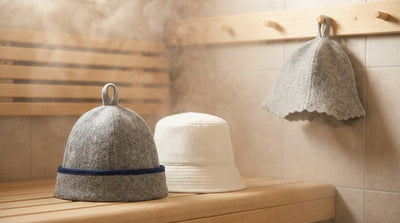
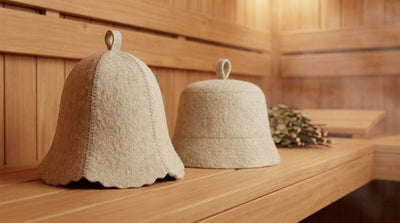
Slightly. A bell-shaped hat has more air gap above the crown, so it can get away with felt on the thinner end of the sweet spot. A bucket-style hat with a brim sits closer to the head but shades the ears and the back of the neck, which many people find keeps them comfortable longer during a hot session. Both benefit from the same medium-firm density. If you're choosing between them, go by fit and preference rather than thickness. Our sauna hats are made to the same felt spec in both shapes for exactly that reason.
Caring for the density you paid for
Even good felt can be ruined. A few habits keep it firm for years:
- Rinse in cool water after use and reshape while damp. Hot water and agitation keep felting the wool, which makes it shrink and stiffen.
- Never put it in a dryer. Air-dry it on a bowl or upside down so it keeps its shape.
- Skip the washing machine. A quick hand rinse is plenty; wool is naturally resistant to odor.
- Store it somewhere dry. A damp hat left in a gym bag will lose its spring.
The short version
Aim for felt that's roughly 3 to 5 mm thick, firm enough to stand on its own and soft enough to flex. Judge density with your hands rather than a ruler. Avoid the two extremes: paper-thin hats that barely insulate, and brick-thick hats that trap sweat and wear like a helmet. Get that balance right and a sauna hat will quietly do its job for years, which is exactly what a good one should do.
Made for the hot room
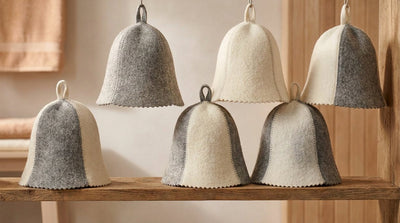
DIVELUX sauna hats are handmade from 100% natural wool felt — breathable, insulating and built to last. 7 colors, classic and bucket styles, $19.99 with free US shipping.
Shop Sauna Hats →