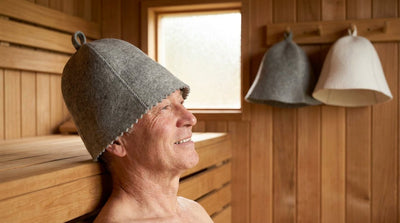
There's a moment in every good sauna session — usually somewhere around minute eight, when the heat has stopped feeling like an event and started feeling like weather — where your thoughts go quiet on their own. You didn't try to make that happen. The room did it for you. That accidental stillness is the seed of sauna meditation: not adding a technique to your sauna, but noticing what the sauna was already doing and giving it a little structure.
Why the sauna is a suspiciously good meditation room
Most meditation advice spends its first ten minutes fighting your environment. Sit still. Put the phone away. Ignore the laundry. The sauna handles all of that before you sit down. No screens, no notifications, nothing to tidy, nowhere to be. The bench is warm, the light is usually low, and the only sound is the occasional hiss of water on stones.
Then there's the heat itself, which is very hard to ignore. In ordinary meditation you're asked to anchor attention on the breath — a subtle sensation that the mind slips off constantly. In a hot room, sensation is loud. Warmth on the shoulders, sweat starting at the temples, the slight scratch of dry air in the throat. You don't have to hunt for something to pay attention to. It's right there, insisting.
Research on sauna bathing suggests sessions may be associated with reductions in perceived stress and improvements in mood, and heat exposure appears to shift the nervous system in ways that resemble deep relaxation. The evidence is promising rather than conclusive, and much of it is observational — so treat the sauna as a pleasant ally, not a prescription. What's harder to argue with is the subjective part: it's genuinely difficult to ruminate about a work email while your body is busy being warm.
Set up so you can actually stay still
Meditation falls apart when your body keeps filing complaints. Half the practice is removing the small irritations that pull you out.
- Hydrate first. A glass or two of water beforehand, more after. Thirst is a very effective concentration-destroyer.
- Pick your bench honestly. The top bench is hotter and more dramatic; the middle bench is where you can sit for fifteen minutes without white-knuckling it. For meditation, choose the one you can stay on.
- Bring a towel to sit on and one to rest your hands on, so you're not fidgeting.
- Cover your head. Your scalp and ears run hot faster than the rest of you, and that "my head is cooking" feeling arrives long before the rest of your body is done. A wool sauna hat insulates the head so the heat stays comfortable instead of urgent — which, for a practice built on not fidgeting, matters more than it sounds. It also spares your hair some of the drying effect of very hot, very dry air.
- Decide the length before you go in. Ten or twelve minutes is plenty. Checking the clock every ninety seconds is its own kind of restlessness.
Timing is worth a thought too. An evening session tends to lend itself to letting go; a morning one is more alert and focused. If you're unsure which suits you, our notes on morning versus evening sauna lay out the tradeoffs.
Three practices to try
1. The body scan (best for beginners)
Start at the crown of your head and move attention slowly downward — forehead, jaw, throat, shoulders, arms, chest, belly, hips, legs, feet. At each stop, just notice the temperature and any tension. Don't fix anything. Let the jaw unclench if it wants to.
A full pass takes three to four minutes. Do two or three passes and the session is over. This one is forgiving: if you lose your place, pick a body part and carry on.
2. Counted breathing
Breathe in through the nose for a count of four, out through the mouth for a count of six. The longer exhale is the point — extended exhalations are associated with parasympathetic activation, which is the physiology of "calming down." Count ten rounds, then rest and simply breathe normally while watching the sensation of air moving.
One caveat: in very hot, dry air, deep nasal breathing can feel harsh. Breathe shallower and slower rather than forcing depth, and never hold your breath in a hot room.
3. Löyly as a bell
In many traditions the pour of water on the stones is the punctuation of a session. Use it as your meditation bell. When the steam arrives, stop whatever you're doing mentally and just receive the wave — the rush of heat across the skin, the sound, the smell. Follow it until it fades. Then return to breathing until the next pour.
Scent deepens this considerably. Birch, eucalyptus and pine give attention something rich to land on, though dosing and safety matter — see our guide to sauna aromatherapy before you start pouring essential oils on hot rocks. If you like the idea of ritualized löyly with a guide leading it, the German Aufguss ritual is the theatrical, communal version of the same instinct.
A simple 12-minute structure
| Minutes | What you're doing | Cue |
|---|---|---|
| 0–2 | Arrive | Sit, settle, let the heat register. No technique yet. |
| 2–5 | Counted breathing | In for 4, out for 6. Ten rounds. |
| 5–9 | Body scan | Crown to feet, slowly, once or twice. |
| 9–11 | Open awareness | Stop directing. Let sound, heat and breath come and go. |
| 11–12 | Close | Notice how you feel. Stand up slowly. |
Repeat for two or three rounds with cool-down breaks between, and you have a session that feels considerably longer than the clock says it was.
What to do when it doesn't work
- Your mind won't stop. Normal. Noticing you've wandered is the practice — the return is the rep, not the failure.
- You're counting the seconds. Usually a sign the bench is too hot or the session too long. Drop down a bench or cut it to eight minutes.
- Your head feels pressurized. Cover it, or get out. Dizziness, headache, nausea or a racing heart mean the session is over — leave calmly and cool down. Heat is not a place to be stoic.
- You fall asleep. Don't. Sleeping in a sauna is genuinely risky. If you're that drowsy, take the win and go to bed instead.
A note on who should be careful: if you're pregnant, have cardiovascular issues, low blood pressure, or take medication that affects heat regulation or hydration, talk to a doctor before making sauna a habit. And never combine heat with alcohol — it impairs exactly the judgment you need in a room that can hurt you.
The cool-down is part of it
Don't sprint from the bench to your phone. The five minutes after you step out — sitting in cool air, skin flushed, heart settling — are often where the calm actually lands. Sit with it. Drink water. Let your body finish what it started.
Your skin has been through something too: a full sweat cycle followed by rapid cooling. A rinse in lukewarm water and a light moisturizer while you're still slightly damp goes a long way, and there's more on the mechanics in our piece on what the sauna does to your skin.
The honest promise of sauna meditation is modest: it won't fix your life, and no research says it will. What it reliably offers is twelve minutes where nothing is required of you, in a room that makes stillness the path of least resistance. Given how rare that is, it's worth showing up for.
Made for the hot room
DIVELUX sauna hats are handmade from 100% natural wool felt — breathable, insulating and built to last. 7 colors, classic and bucket styles, $19.99 with free US shipping.
Shop Sauna Hats →