Walk into any well-loved banya in Eastern Europe and you'll see a room full of people in what look like felted wizard hats. Walk into an American gym sauna and you'll occasionally spot someone in a cotton baseball cap or a damp cotton beanie, wondering why their head still feels like it's baking. The difference isn't tradition for tradition's sake — it's textile science. Wool and cotton behave in almost opposite ways when the thermometer climbs past 170°F, and once you understand why, you'll never bring a cotton cap into the hot room again.
Why your head needs protection in the first place
Heat rises, and in a sauna it rises with enthusiasm. The air near the ceiling — right where your head sits on the upper bench — can be 20 to 40 degrees hotter than the air at your feet. Your scalp, ears, and hair take the brunt of it.
That matters for two reasons. First, comfort and endurance: many sauna-goers find that when their head overheats, the whole session ends early, even if the rest of their body was perfectly happy. Research on sauna bathing suggests that keeping the head cooler may help people tolerate longer sessions more comfortably, which is exactly why the sauna hat tradition developed in Russian and Finnish bathing cultures. Second, your hair: dry heat can strip moisture from the hair shaft, leaving it brittle and frizzy. A good hat acts like a tiny personal climate zone for everything above your shoulders.
So a hat is a smart idea. The question is which fabric you put between your head and the heat — and this is where cotton quietly betrays you.
What cotton actually does in a hot room
Cotton is a wonderful fiber. We love it in t-shirts, bedsheets, and towels precisely because of what it does best: it absorbs water eagerly and holds onto it. In a sauna, that superpower becomes a liability, for three connected reasons.
1. Cotton soaks up sweat and steam — then stops insulating
A cotton cap in a sauna becomes saturated fast, drinking up your sweat and the humidity in the air. Wet cotton loses most of its insulating ability; the water fills the air spaces in the fabric, and water conducts heat far better than air does. Within ten or fifteen minutes, that cap isn't a barrier anymore. It's a warm, wet compress pressed against your scalp.
2. Wet cotton transfers heat toward your head
Here's the counterintuitive part: a saturated cotton cap can make your head feel hotter than wearing nothing at all. The waterlogged fabric sits flush against your skin, conducting the room's heat directly to your scalp while also trapping your sweat so it can't evaporate and cool you. You get the worst of both worlds — heat coming in, cooling going nowhere.
3. It gets heavy, droopy, and frankly a bit gross
A soaked cotton beanie sags over your eyes, drips down your neck, and takes ages to dry between rounds. And because cotton holds moisture so long, it becomes a cozy home for mildew and that unmistakable "gym bag" smell if you don't wash it constantly.
What wool does differently
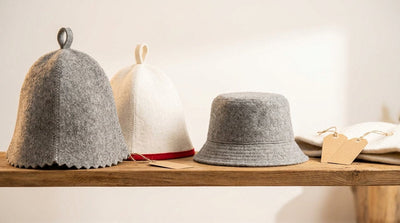
Wool — especially thick felted wool, the traditional sauna hat material — is built for exactly this job. Sheep spend their lives outdoors in rain, snow, and sun, and their fleece evolved to regulate temperature in all of it. Three properties make it the sauna champion:
- Trapped air, and lots of it. Wool fibers are naturally crimped, like tiny springs. Felted together, they create millions of microscopic air pockets, and still air is one of the best insulators there is. That air layer is what keeps the ceiling-level heat from reaching your scalp.
- It manages moisture without saturating. Wool can absorb a surprising amount of water vapor — up to roughly a third of its weight — inside the fiber itself, while the surface stays comparatively dry. Those insulating air pockets keep doing their job even as the hat takes on humidity. Cotton floods; wool buffers.
- It's naturally odor-resistant. Wool's fiber structure and lanolin traces make it less hospitable to odor-causing bacteria, so a wool hat can go many sessions between washes with nothing more than a good airing-out.
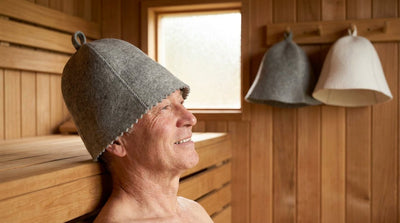
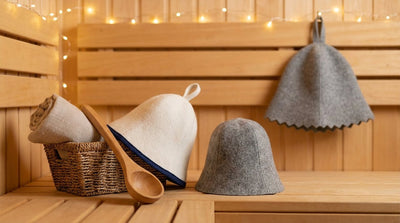
This is why a proper wool sauna hat is thick, felted, and slightly oversized — the loft is the point. It keeps your head noticeably cooler, your ears shielded, and your hair protected from the drying heat, round after round.
Wool vs. cotton at a glance
| Property | Felted wool | Cotton |
|---|---|---|
| Insulation when dry | Excellent — crimped fibers trap air | Modest — flat fibers, thin fabric |
| Insulation when damp | Still good — retains loft and air pockets | Poor — saturates and conducts heat |
| Moisture behavior | Buffers vapor inside the fiber | Soaks through, clings to skin |
| Odor after repeated use | Naturally resistant; air-dry between sessions | Needs frequent washing |
| Comfort late in a session | Stays light and dry-feeling | Heavy, droopy, drippy |
| Drying time between rounds | Quick surface dry | Slow; often still damp next round |
"But can't I just use a wet towel?"
You'll see this workaround in a lot of American spas, and to be fair, a towel draped over your head is better than nothing — it shades your ears and briefly cools as the water evaporates. But it's cotton, so the same physics apply: once it warms through, it's a hot wet blanket, and you'll be re-soaking it every few minutes. It also tends to slide off the moment you lean back. If you're sauna-ing in a shared facility, a hat is also simply tidier — no dripping towel to wring out over the bench (your fellow bathers will thank you; we cover more of these unwritten rules in our guide to sauna etiquette in American gyms and spas).
One note: fabric choice matters most in traditional hot-air saunas and steam-forward banyas, where ambient ceiling heat is the enemy. If you mostly use infrared cabins, the physics are a little different — we break that down in our honest comparison of infrared and traditional saunas.
Getting the most out of a wool hat
- Wear it dry. Unlike the towel trick, a wool hat works best dry — the trapped air does the cooling math for you.
- Pull it down over your ears. Ears are thin-skinned and heat-sensitive; they're half the reason the traditional bell shape exists.
- Air it out after each session. Hang it somewhere ventilated, away from direct heat. Skip the washing machine — hand-wash occasionally in cool water if needed, and never tumble dry unless you want a hat sized for a toddler (though if you actually have a toddler joining you, see our guide to kids in the sauna).
- Expect it to develop character. Felted wool softens and molds slightly to your head over time. That's not wear — that's a hat becoming yours.
Cotton earned its place in almost every corner of your wardrobe. The sauna just isn't one of them. Up on that top bench, where the air shimmers and the löyly rolls over you, wool is the fiber that's been doing the job for centuries — and doing it well enough that nobody's found a reason to replace it.
Made for the hot room
DIVELUX sauna hats are handmade from 100% natural wool felt — breathable, insulating and built to last. 7 colors, classic and bucket styles, $19.99 with free US shipping.
Shop Sauna Hats →