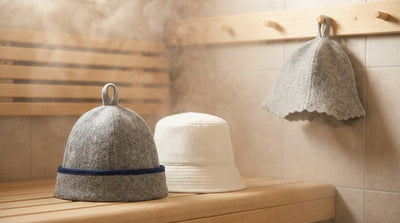
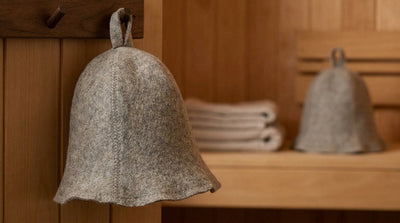
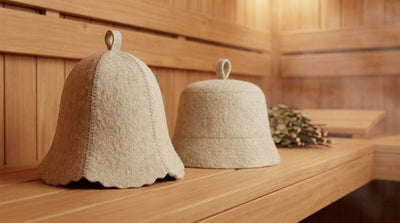
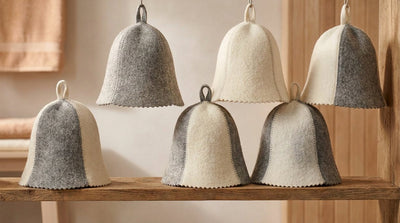
Ten dollars for a sauna hat sounds like a bargain — until you're sitting on the top bench wondering why your head is sweating through what feels like a damp oven mitt. We make sauna hats for a living, so yes, we have opinions. But we also have a pretty simple test for whether a cheap hat is worth it: what is it actually made of, and what does that material do at 190°F? Let's take an honest look, because sometimes the $10 hat is genuinely fine — and sometimes it's a felt-shaped disappointment.
Why a Sauna Hat Exists in the First Place
A sauna hat has one job: keep your head cooler than the air around it. Heat rises, so the air near the ceiling of a sauna — right where your head sits — can be 20–40°F hotter than at bench level. Your head, meanwhile, is one of the most heat-sensitive parts of your body. When it overheats, sessions feel shorter, dizziness creeps in sooner, and your hair and scalp take the brunt of the dry heat.
A good hat works like the insulation in your attic, just in reverse: it slows heat transfer from the air to your head. That buys you longer, more comfortable sessions — which is where most of the benefits people chase in the sauna actually come from. (If you're pairing longer sessions with a calmer mind, our guide to breathing techniques for the sauna is a nice companion read.)
So the question "is a cheap hat worth it?" really means: "does this material insulate?" Everything else — stitching, shape, smell — is downstream of that.
What's Actually Inside a $10 Sauna Hat
Flip over the listing on a bargain sauna hat and you'll usually find one of four things. They are not created equal.
1. Synthetic "felt" (polyester or acrylic)
This is the most common budget material, because it's cheap to produce and looks convincingly wooly in photos. The problem: polyester is plastic. Plastic is a poor insulator compared to wool, it traps sweat against your skin instead of absorbing it, and at high sauna temperatures some synthetics can soften, deform, or give off a faint chemical smell. It won't melt onto your head — but it will get clammy, floppy, and vaguely sad within a few months.
2. Wool blends (often 30–70% wool)
Better, but read the fine print. A "wool felt" hat that's 40% wool and 60% polyester behaves mostly like the polyester. Blends also tend to pill and thin out faster, because the synthetic fibers don't lock together the way pure wool fibers do during felting.
3. Thin 100% wool
Here's the sneaky one. A hat can honestly say "100% wool" and still underperform, because insulation depends on thickness and density, not just fiber content. Some budget hats use wool felt so thin you can nearly see light through it. It's real wool — there's just not enough of it between your scalp and the heat.
4. Proper thick wool felt
This is the traditional material, used in Russian and Finnish bathhouses for generations: dense, 100% natural wool, felted thick enough to hold its shape on its own. Wool fibers trap millions of tiny air pockets, and still air is one of the best insulators there is. Wool can also absorb a significant amount of moisture before it feels wet, and it's naturally flame-resistant. There's a reason nobody ever "disrupted" this material — it already works.
A Quick Side-by-Side
| Material | Insulation | Sweat handling | Typical lifespan | Feel in the heat |
|---|---|---|---|---|
| Synthetic felt | Poor | Traps sweat, gets clammy | A few months | Hot, sticky |
| Wool blend | Fair | Mixed — depends on wool % | 6–12 months | Okay, pills quickly |
| Thin 100% wool | Fair | Good | 1–2 years | Better, but heat gets through |
| Thick 100% wool felt | Excellent | Absorbs without feeling wet | Years, with basic care | Noticeably cooler head |
How to Spot a Cheap Hat Before You Buy
Listings don't always tell the truth, but they usually leave clues. Here's what we'd check:
- The exact fiber content. "Felt" alone means nothing — felt is a construction, not a material. Look for "100% wool" stated plainly. If the material isn't listed at all, assume synthetic.
- Structure in the photos. A proper wool felt hat stands up on its own like a little bell. If the hat is photographed lying flat and floppy like a beanie, it's too thin to insulate well.
- The smell test (post-purchase). Real wool has a faint, natural lanolin scent. A sharp chemical smell out of the bag is a polyester tell.
- The burn-hole reviews. Skim the one-star reviews for words like "melted," "warped," or "smelled like plastic." Sauna heat is an honest reviewer.
- Suspiciously low weight. Dense wool felt has some heft to it. A hat that weighs about as much as a paper towel isn't holding much air — or much heat back.
So… Is a Cheap Hat Ever Worth It?
Honestly? Sometimes. If you sauna a few times a year at a hotel gym and just want something on your head, a $10 hat is better than no hat — even mediocre insulation beats bare scalp in a 190°F room. No shame in it.
But if you sauna weekly, the math shifts fast. A synthetic hat that lasts one season and never really keeps your head cool isn't a $10 purchase — it's a $10 subscription. A well-made wool sauna hat in thick natural felt costs about twice as much, lasts for years, and actually does the job you bought it for: cooler head, longer sessions, hair that isn't fried by dry heat. If longer, more comfortable sessions are the goal — whether that's for relaxation or the sweat-related benefits people ask about in our sauna and weight loss deep-dive — the hat that lets you stay in comfortably is the one earning its keep.
One more honest note: no hat, cheap or premium, makes sauna time medically risk-free. A good hat may help you feel comfortable longer, but listen to your body first — dizziness, nausea, or a racing heart mean it's time to step out, whatever your head is wearing.
Caring for Wool So It Outlives the Cheap Stuff
Part of what makes real wool worth the extra ten dollars is how little it asks of you:
- After each session, shake it out and let it air-dry on a shelf — never on a radiator or in a dryer, which can shrink wool.
- Every month or so, spot-clean with cool water and a drop of mild soap if needed.
- Store it somewhere dry and ventilated. That's it. No delicate cycles, no reshaping rituals.
Treated this way, a thick wool felt hat will still be standing at attention years from now — long after its synthetic cousins have flopped, pilled, and moved on to the great lost-and-found bin in the sky. And if you end up loving yours, fair warning: they tend to multiply. Matching hats for two are a thing, and we've made the case for his-and-hers sets before.
Made for the hot room
DIVELUX sauna hats are handmade from 100% natural wool felt — breathable, insulating and built to last. 7 colors, classic and bucket styles, $19.99 with free US shipping.
Shop Sauna Hats →