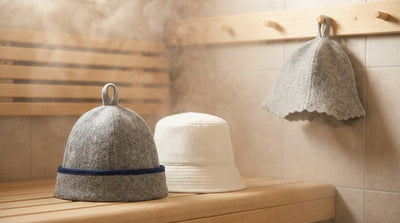
You're standing at the sauna door with a beanie in one hand and a baseball cap in the other, wondering if either will save your ears. Fair question. Plenty of people grab whatever hat is on the hook, and some of them get away with it. But at 195°F, materials behave very differently than they do on a chilly morning walk, and a few common fabrics turn from harmless to genuinely uncomfortable, or worse. Here's what actually happens to everyday hats in a hot room, and why the old-school wool felt design has outlasted every trend.
Why a hat in the sauna at all?
Hot air rises, so the top of your head sits in the hottest layer of the room. Your scalp and ears are thin-skinned and full of blood vessels, which is why they're the first thing to feel like they're baking. A sauna hat works as insulation: it slows the transfer of heat into your head so your core can warm up gradually while your brain stays a little cooler. Many bathers find they can sit longer and more comfortably with one, and it also shields hair from hot, dry air that may leave it brittle over time. That's the whole job. The question is which materials can do it.
The short answer
You can wear a regular hat in the sauna. Whether you should depends entirely on what it's made of and what's attached to it. Some hats are merely useless in the heat. Others hold moisture against your scalp, melt, or carry metal bits that turn into tiny branding irons. The material list below is roughly in order from "please don't" to "this is the real thing."
Material by material: what happens at 195°F
Polyester, nylon and acrylic (most beanies and sports caps)
Synthetic fibers are plastic, and plastic conducts heat far better than wool does. A polyester beanie doesn't insulate your head so much as it clings to it, trapping sweat with nowhere to go. Within minutes it's a warm, wet compress. Synthetic fabrics also start to soften at temperatures not wildly above sauna range, so while a typical Finnish sauna won't melt them outright, repeated cycles can leave them misshapen and faintly smelly. If you ever sit near the stove or ladle water onto hot rocks, steam can push surface temperatures higher still. Not worth the gamble.
Cotton (baseball caps, bucket hats, bandanas)
Cotton won't melt, and it feels innocent, but it's a sponge. It absorbs sweat and steam, then holds that hot moisture right against your skin. Wet cotton conducts heat much better than dry cotton, so a soaked cap can make your head feel hotter, not cooler. It also dries slowly, which is why a cotton cap after three sauna rounds feels like a warm dishrag. Fine in a pinch, but it's doing very little of the job you want.
Anything with metal, plastic or glue
Snapback buttons, rivets, metal eyelets, plastic brim inserts, iron-on logos and glued-in sweatbands all react badly to heat. Metal warms fast enough to leave a small mark on your forehead, glue can soften and release a chemical smell, and stiff plastic brims can warp. Check the inside of any hat before you bring it in. If there's a hard component touching skin, leave it in the locker.
Straw and paper hats
Straw actually breathes well and won't hold much sweat, which is why you'll occasionally see them in banya photos. The catch is that they're brittle, they shed, and many are held together with glue or a synthetic band. They're also not insulating in any meaningful way. Charming, not practical.
Linen and cotton felt
Some sellers offer "felt" hats that are really compressed cotton or a cotton-synthetic blend. They look the part, but they behave like thick cotton: they absorb moisture and lose insulating power as they get wet. If you're unsure what you've bought, our guide to spotting fake wool felt with burn, smell and touch tests walks through how to tell in about a minute.
100% wool felt
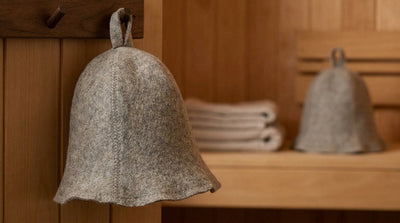
This is why the classic sauna hat looks the way it does. Wool fibers are crimped and hollow, which traps a lot of still air, and still air is an excellent insulator. Wool also handles moisture in a way no synthetic does: it can absorb a fair amount of water vapor into the fiber itself while the surface still feels dry, and it keeps insulating even when damp. It's naturally flame-resistant, doesn't melt, and doesn't hold odor the way plastics do. A well-made wool sauna hat is thick, seam-light, and has no hardware at all, so there's simply nothing to heat up or go wrong.
Quick comparison
| Material | Insulates? | Handles sweat? | Safe at 195°F? | Verdict |
|---|---|---|---|---|
| Polyester / acrylic | Poorly | No, traps it | Marginal | Skip it |
| Cotton | Barely | Absorbs and holds | Yes | Better than nothing |
| Hats with metal/plastic parts | Varies | Varies | No | Leave outside |
| Straw | No | Fine | Mostly | Decorative |
| 100% wool felt | Yes | Yes, stays comfortable | Yes | The real thing |
What about wearing nothing?
Totally fine, and plenty of people do. A hat isn't a safety requirement. It's a comfort tool, and for some it's the difference between a five-minute round and a relaxed fifteen. If you find yourself leaving early because your ears sting or your scalp feels tight, that's the signal a hat may help. If you're happy bareheaded, carry on.
Signs your current hat isn't cutting it
- It's soaked through and heavy after one round.
- Your head feels hotter with it on than off.
- You notice a plasticky or chemical smell as it warms up.
- Any part of it is hot to the touch when you take it off.
- It's changed shape or stiffened after a few sessions.
If you decide to buy a proper one
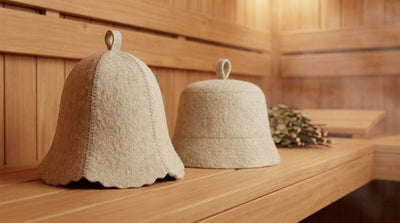
A few things matter more than the color you pick. Look for 100% wool with no synthetic blend, a thick enough felt that it holds its shape on its own, and zero hardware. Thickness is its own small rabbit hole, and our sauna hat thickness guide explains why denser felt tends to insulate better without being heavier. Shape is mostly preference: the traditional bell sits deep over the ears, while a brimmed bucket style gives a little extra shade over the eyes and neck, which some people like near a hot stove. Either way, the good ones don't need to cost much. We broke down where the money goes in what a sauna hat should actually cost, and the honest answer is that a well-felted wool hat lands around the price of a couple of nice coffees.
Caring for a wool sauna hat
- After each session, shake it out and let it air-dry on a hook, away from direct heat. Never tumble dry.
- Every few weeks, rinse it in cool water with a drop of gentle soap, press out the water with a towel, and reshape by hand.
- Skip fabric softener and hot water, both of which can cause the felt to shrink or go limp.
- If it starts to lose its shape, wet it, stretch it over a bowl or your knee, and let it dry that way.
So yes, a regular hat will technically go into the sauna with you. But at 195°F, a cotton cap becomes a wet towel, a synthetic beanie becomes a slow cooker, and a snapback becomes a small hazard. Wool felt was the answer long before anyone tested it in a lab, and it's still the answer now. Your ears will let you know.
Made for the hot room
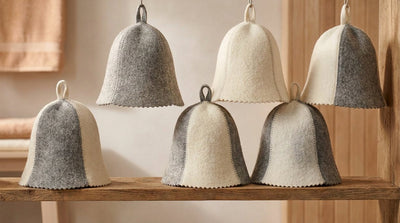
DIVELUX sauna hats are handmade from 100% natural wool felt — breathable, insulating and built to last. 7 colors, classic and bucket styles, $19.99 with free US shipping.
Shop Sauna Hats →